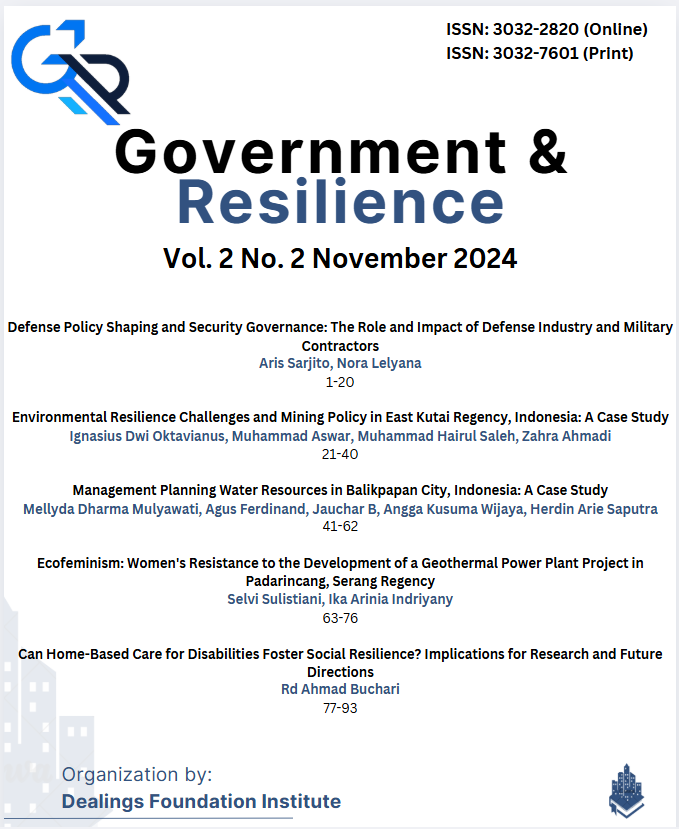
Ecofeminism: Women's Resistance to the Development of a Geothermal Power Plant Project in Padarincang, Serang Regency
DOI:
https://doi.org/10.62503/gr.v2i2.19Keywords:
Women's Resistance, Geothermal Power Plant, Ecofeminism, Renewable Energy, Environmental ImpactAbstract
This article examines the women's resistance movement in Padarincang District, Serang Regency, against the development of a Geothermal Power Plant, analyzed through an ecofeminist perspective. As human dependence on energy grows, there is increasing pressure to find alternative energy sources, such as geothermal energy, to meet daily needs. The proposed Geothermal Power Plant in Padarincang is part of Indonesia’s commitment to achieving Net Zero Emissions (NZE). However, local resistance emerged due to concerns over the potential economic and environmental impacts of the project. Using qualitative research methods and a case study approach, this study explores how women in Padarincang District contributed to the ecological movement. The findings reveal that the rejection stemmed from a lack of slot thailand community engagement and socialization about the development, leading to fears of environmental degradation. Many locals did not understand that geothermal energy could offer new opportunities for renewable energy. The resistance, particularly from women, gave rise to an ecofeminist movement addressing these environmental issues. This research contributes to the literature on the intersection of gender and environmental concerns, particularly by highlighting the role of women in such movements.
References
Adityatama, D. W., Purba, D. P., & Muhammad, F. (2019). Manajemen Risiko dalam Pengeboran Eksplorasi Panas Bumi di Indonesia. Swara Patra, 9(2), 1–17.
Andini, T. N., Hidayat, D. N., Husna, N., & Alek, A. (2023). A CRITICAL DISCOURSE ANALYSIS OF GENDER REPRESENTATIONS IN EFL TEXTBOOK OF SENIOR HIGH SCHOOL. Getsempena English Education Journal, 10(1), 55–72. https://doi.org/10.46244/geej.v10i1.2041
Arni, N., & Nur, A. (2021). Resistensi Perempuan terhadap Kuasa di Balik Kasus Perampasan Ruang Hidup: Studi Ekofeminisme. Najwa : Jurnal Muslimah Dan Studi Gender, 1(1), 60–72.
Astuti, T. M. P. (2012). Ekofeminisme Dan Peran Perempuan Dalam Lingkungan. Indonesian Journal of Conservation, 1(1).
Azu, V. N. (2024). Women in Climate Change Crises Solutions: Centrality and Empowerment for Resilience. Gusau International Journal of Management and Social Sciences, 7(2), 157–175. https://doi.org/10.57233/gijmss.v7i2.09
Bangun, B. H. (2020). Ecofeminism and Enviromental Protection: A Legal Perspective. Jambe Law Journal, 3(1), 1–18. https://doi.org/10.22437/jlj.3.1.1-18
Bell, S. E., Daggett, C., & Labuski, C. (2020). Toward feminist energy systems: Why adding women and solar panels is not enough✰. Energy Research & Social Science, 68, 101557. https://doi.org/10.1016/j.erss.2020.101557
Bozkurt, A., & Genç, M. S. (2024). Optimization of Energy and Hydrogen Storage Systems in Geothermal Energy Sourced Hybrid Renewable Energy System. Process Safety and Environmental Protection, 189, 1052–1060. https://doi.org/https://doi.org/10.1016/j.psep.2024.06.128
Brisman, A., & South, N. (2019). Green Criminology and Environmental Crimes and Harms. Sociology Compass, 13(1), 373–390. https://doi.org/10.1111/soc4.12650
Brito-Millán, M., Helland, L. F., Morales, J. G., Harrison, E., Ng, J., Quintanilla, L., Salomón J, A., & werner, bt. (2023). Rejecting Green Colonial Solutions: Towards Decolonial Solidarity with Mother Earth’s Revolt. Perspectives on Global Development and Technology, 21(5–6), 338–359. https://doi.org/https://doi.org/10.1163/15691497-12341637
Campos, I., & Marín-González, E. (2020). People in transitions: Energy citizenship, prosumerism and social movements in Europe. Energy Research & Social Science, 69, 101718. https://doi.org/10.1016/j.erss.2020.101718
Chakrabarty, A. (2023). Feminizing Decentralized Renewable Energy Programs: A Study of a Community Renewable Energy Project from India. Journal of Asian Energy Studies, 7, 107–120. https://doi.org/10.24112/jaes.070008
Chen, S., Zhang, Q., Andrews-Speed, P., & Mclellan, B. (2020). Quantitative assessment of the environmental risks of geothermal energy: A review. Journal of Environmental Management, 276, 111287. https://doi.org/10.1016/j.jenvman.2020.111287
Creswell, J. W., & Creswell, J. D. (2018). Qualitative, Quantitative, and Mixed Methods Approaches (fifth). SAGE Publications.
Dhar, A., Naeth, M. A., Jennings, P. D., & Gamal El-Din, M. (2020). Geothermal energy resources: potential environmental impact and land reclamation. Environmental Reviews, 28(4), 415–427. https://doi.org/10.1139/er-2019-0069
Fahimah, S. (2017). Ekofeminisme: Teori Dan Gerakan. Alamtara : Jurnal Komunikasi Dan Penyiaran Islam, 1, 6–19.
Fitri, A. I., & Akbar, I. (2017). GERAKAN SOSIAL PEREMPUAN EKOFEMINISME DI PEGUNUNGAN KENDENG PROVINSI JAWA TENGAH MELAWAN PEMBANGUNAN TAMBANG SEMEN. CosmoGov, 3(1), 83. https://doi.org/10.24198/cosmogov.v3i1.12634
Gimeno-Sánchez, A. (2022). Urbanism of zines: the potential of environmentalist zines as sources for planning history. Planning Perspectives, 37(6), 1115–1146. https://doi.org/10.1080/02665433.2022.2025887
Gkousis, S., Welkenhuysen, K., & Compernolle, T. (2022). Deep geothermal energy extraction, a review on environmental hotspots with focus on geo-technical site conditions. Renewable and Sustainable Energy Reviews, 162, 112430. https://doi.org/10.1016/j.rser.2022.112430
Goswami, S., & Rai, A. K. (2024). An Assessment of Prospects of Geothermal Energy in India for Energy Sustainability. Renewable Energy, 233, 121118. https://doi.org/https://doi.org/10.1016/j.renene.2024.121118
Hamstead, Z. A. (2024). Thermal insecurity: Violence of heat and cold in the urban climate refuge. Urban Studies, 61(3), 531–548. https://doi.org/10.1177/00420980231184466
Hardiningtyas, P. (2016). Resistansi Perempuan Papua Di Lingkungannya Dalam Roman Isinga Karya Dorothea Rosa Herliany the Resistance of Papuan Women in Her Environment in Isinga Romance By Dorothea Rosa Herliany. Aksara, 28(2), 143–156.
Idroes, G. M., Hardi, I., Hilal, I. S., Utami, R. T., Noviandy, T. R., & Idroes, R. (2024). Economic Growth and Environmental Impact: Assessing the Role of Geothermal Energy in Developing and Developed Countries. Innovation and Green Development, 3(3), 100144. https://doi.org/https://doi.org/10.1016/j.igd.2024.100144
Idroes, G. M., Syahnur, S., Majid, M. S. A., Idroes, R., Kusumo, F., & Hardi, I. (2023). Unveiling the Carbon Footprint: Biomass vs. Geothermal Energy in Indonesia. Ekonomikalia Journal of Economics, 1(1), 10–18. https://doi.org/10.60084/eje.v1i1.47
Jatnika, J., & Amal, M. I. (2023). Tantangan Implementasi Net Zero Emission di Banten: Studi Kasus Pembangunan Geothermal Padarincang. Ijd-Demos, 5(4). https://doi.org/10.37950/ijd.v5i4.433
Karayel, G. K., Javani, N., & Dincer, I. (2022). Effective use of geothermal energy for hydrogen production: A comprehensive application. Energy, 249, 123597. https://doi.org/https://doi.org/10.1016/j.energy.2022.123597
Lieu, J., Sorman, A. H., Johnson, O. W., Virla, L. D., & Resurrección, B. P. (2020). Three sides to every story: Gender perspectives in energy transition pathways in Canada, Kenya and Spain. Energy Research & Social Science, 68, 101550. https://doi.org/10.1016/j.erss.2020.101550
Lockley, A., Marcoes, L., Nugroho, K., & Boang-Manalu, A. G. (2019). Women’s Collective Action for Empowerment in Indonesia. Jurnal Perempuan, 24(1), 13. https://doi.org/10.34309/jp.v24i1.309
Mies, M., & Shiva, V. (1993). Ecofeminism. London: Zed Books
Mott, A., Baba, A., Hadi Mosleh, M., Ökten, H. E., Babaei, M., Gören, A. Y., Feng, C., Recepoğlu, Y. K., Uzelli, T., Uytun, H., Morata, D., Yüksel, A., & Sedighi, M. (2022). Boron in geothermal energy: Sources, environmental impacts, and management in geothermal fluid. Renewable and Sustainable Energy Reviews, 167, 112825. https://doi.org/https://doi.org/10.1016/j.rser.2022.112825
Nagari, H. P. (2020). Gerakan Sosial Ekofeminisme Melawan Penambangan Marmer di Gunung Mutis Nusa Tenggara Timur. Ijd-Demos, 2(1), 58–67. https://doi.org/10.37950/ijd.v2i1.33
Paulillo, A., Cotton, L., Law, R., Striolo, A., & Lettieri, P. (2020). Geothermal energy in the UK: The life-cycle environmental impacts of electricity production from the United Downs Deep Geothermal Power project. Journal of Cleaner Production, 249, 119410. https://doi.org/10.1016/j.jclepro.2019.119410
Rahman, A., Farrok, O., & Haque, M. M. (2022). Environmental impact of renewable energy source based electrical power plants: Solar, wind, hydroelectric, biomass, geothermal, tidal, ocean, and osmotic. Renewable and Sustainable Energy Reviews, 161, 112279. https://doi.org/10.1016/j.rser.2022.112279
R.V., R., R., V. R., Kiplangat, D. C., R., V., Jose, R., Pradeepkumar, A. P., & Kumar, K. S. (2023). Tracing the evolution and charting the future of geothermal energy research and development. Renewable and Sustainable Energy Reviews, 184, 113531. https://doi.org/10.1016/j.rser.2023.113531
Sari, N., Yunus, R., & Suparman, S. (2019). Ekofeminisme: Konstruksi Sosial Budaya Perilaku Perempuan Dalam Pengelolaan Lingkungan Hidup. Palita: Journal of Social Religion Research, 4(2), 161–178. https://doi.org/10.24256/pal.v4i2.760
Sayed, E. T., Wilberforce, T., Elsaid, K., Rabaia, M. K. H., Abdelkareem, M. A., Chae, K.-J., & Olabi, A. G. (2021). A critical review on environmental impacts of renewable energy systems and mitigation strategies: Wind, hydro, biomass and geothermal. Science of The Total Environment, 766, 144505. https://doi.org/10.1016/j.scitotenv.2020.144505
Scharnigg, R., & Martin, A. (2024). Gendered sociotechnical imaginaries: Understanding the role of masculinities in Portugal’s pursuit of multi-scalar solar energy transitions. Energy Research & Social Science, 108, 103372. https://doi.org/10.1016/j.erss.2023.103372
Sharmin, T., Khan, N. R., Akram, M. S., & Ehsan, M. M. (2023). A State-of-the-Art Review on Geothermal Energy Extraction, Utilization, and Improvement Strategies: Conventional, Hybridized, and Enhanced Geothermal Systems. International Journal of Thermofluids, 18, 100323. https://doi.org/10.1016/j.ijft.2023.100323
Soltani, M., Moradi Kashkooli, F., Souri, M., Rafiei, B., Jabarifar, M., Gharali, K., & Nathwani, J. S. (2021). Environmental, Economic, and Social Impacts of Geothermal Energy Systems. Renewable and Sustainable Energy Reviews, 140, 110750. https://doi.org/https://doi.org/10.1016/j.rser.2021.110750
Somoye, O. A., & Akinwande, T. S. (2024). Exploring the association between the female gender, education expenditure, renewable energy consumption and CO 2 emissions: Empirical evidence from Nigeria. OPEC Energy Review. https://doi.org/10.1111/opec.12305
Sukmawan, A. (2018). Kebijakan Pemerintah Dan Hukum Pidana Terhadap Pembangunan Listrik Tenaga Panas Bumi(Studi Kasus Padarincang,Banten ). Logika : Journal of Multidisciplinary Studies, 9(02), 57–64. https://doi.org/10.25134/logika.v9i02.2467
Sumotarto, U., Hendrasto, F., & Triadi, W. (2019). Volcanostratigraphy of Batukuwung-Parakasak Geothermal Area, Serang Regency, West Java. Journal of Physics: Conference Series, 1363(1). https://doi.org/10.1088/1742-6596/1363/1/012048
Taqiyaah, A., & Hidayat, A. (2023). Laws Concerning Mineral and Coal Mining on Community Welfare from an Environmental Ethics Perspective. Indonesian Journal of Environmental Law and Sustainable Development, 2(2). https://doi.org/10.15294/ijel.v2i2.70333
Umar, M., Awosusi, A. A., Adegboye, O. R., & Ojekemi, O. S. (2024). Geothermal energy and carbon emissions nexus in leading geothermal-consuming nations: Evidence from nonparametric analysis. Energy & Environment, 35(5), 2726–2752. https://doi.org/10.1177/0958305X231153972
Wiyatmi, W., Suryaman, M., & Swatikasari, E. (2019). Developing an ecofeminist literary criticism model to cultivate an ecologically aware and feminist generation. Interdisciplinary Literary Studies, 21(4), 515–531. https://doi.org/10.5325/intelitestud.21.4.0515
Wulan, T. R. (2007). Ekofeminisme Transformatif : Alternatif Kritis. Jurnal.Ipb.Ac.Id, 01(01), 105–130.
Xia, Z. H., Jia, G. S., Ma, Z. D., Wang, J. W., Zhang, Y. P., & Jin, L. W. (2021). Analysis of economy, thermal efficiency and environmental impact of geothermal heating system based on life cycle assessments. Applied Energy, 303, 117671. https://doi.org/10.1016/j.apenergy.2021.117671
Yilmaz, F. (2021). Performance and environmental impact assessment of a geothermal-assisted combined plant for multi-generation products. Sustainable Energy Technologies and Assessments, 46, 101291. https://doi.org/10.1016/j.seta.2021.101291
Yunus, K., Zuraidah, M. A., & John, A. (2020). A review on the accumulation of heavy metals in coastal sediment of Peninsular Malaysia. Ecofeminism and Climate Change, 1(1), 21–35. https://doi.org/10.1108/EFCC-03-2020-0003
Zhang, L., Wang, Y., Ding, B., Gu, J., Ukrainczyk, N., & Cai, J. (2023). Development of Geopolymer-Based Composites for Geothermal Energy Applications. Journal of Cleaner Production, 419, 138202. https://doi.org/https://doi.org/10.1016/j.jclepro.2023.138202
Downloads
Published
Issue
Section
License
Copyright (c) 2024 Government & Resilience

This work is licensed under a Creative Commons Attribution-NonCommercial-ShareAlike 4.0 International License.
All articles published in Government & Resilience (G&R) are licensed under the Creative Commons Attribution-NonCommercial-ShareAlike 4.0 International (CC BY-NC-SA 4.0) license.
Under this license, authors retain the copyright to their work while granting Government & Resilience (G&R) the non-exclusive right to publish, distribute, and identify itself as the original publisher of the article.
The CC BY-NC-SA 4.0 license permits anyone to copy, distribute, display, perform, and adapt the published work for non-commercial purposes, provided that:
- appropriate credit is given to the original author(s) and the journal;
- a link to the CC BY-NC-SA 4.0 license is provided;
- any changes made are clearly indicated; and
- any derivative works are distributed under the same CC BY-NC-SA 4.0 license.
Commercial use of the published material requires prior permission from the copyright holder(s).
Authors are free to deposit the published version of their articles in institutional repositories, personal websites, or other non-commercial platforms, provided that proper acknowledgment is given to the original publication in Government & Resilience (G&R).
A link to the full license text should also be provided: https://creativecommons.org/licenses/by-nc-sa/4.0/