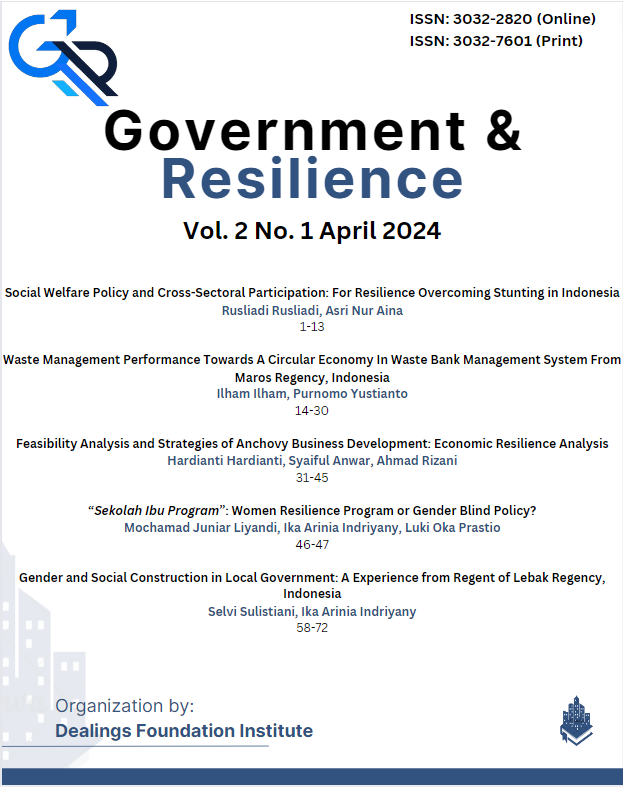
Waste Management Performance Towards A Circular Economy In Waste Bank Management System From Maros Regency, Indonesia
DOI:
https://doi.org/10.62503/gr.v2i1.11Keywords:
Waste Management Performance, Circular Economy Development, Waste Bank, SDGs, Maros RegencyAbstract
Waste management has been in the spotlight in recent years because the amount of waste generated each year is increasing. The circular economy is an economic concept that implements sustainable development goals related to responsible and sustainable levels of consumption and production that can support the community's economy. This study aims to determine performance in understanding waste development and management towards developing an efficient city waste management system that can become a circular economy. The methodology used in this research is an interpretive descriptive qualitative method with a case study approach in Maros Regency, Indonesia, a way of collecting data obtained from various trusted references such as journals, books, etc., this data is then processed by the author. The results of the research show that the performance of the existing waste management system in Maros Regency is running well. The involvement of stakeholders in forming community participation to implement a circular economic system is very helpful because the community can independently improve the economy by managing waste. The Turikale Waste Bank is the central bank. The waste management in Maros Regency is successful because it can provide a turnover of tens of millions per month.
References
Ajrina, F. I., & Putri, H. T. (2020). Kinerja Pengelolaan Sampah Kota Bandar Lampung Berdasarkan Sudut Pandang Pemerintah. Lampung: Institut Teknologi Sumatera. https://repo.itera.ac.id/assets/file_upload/SB2009100065/22116092_20_163632
Balwada, Jaideep, Samaiya, Shivam, & Mishra, Rajesh P. (2021). Packaging Plastic Waste Management for a Circular Economy and Identifying a better Waste Collection System using Analytical Hierarchy Process (AHP). Procedia CIRP, 98, 270275. https://doi.org/https://doi.org/10.1016/j.procir.2021.01.102
Bucknall, David. (2020). Plastics as a materials system in a circular economy. Philosophical Transactions of the Royal Society A: Mathematical, Physical and Engineering Sciences, 378, 20190268. https://doi.org/10.1098/rsta.2019.0268
Budihardjo, M. A., Humaira, N. G., Ramadan, B. S., Wahyuningrum, I. F. S., & Huboyo, H. S. (2023). Strategies to reduce greenhouse gas emissions from municipal solid waste management in Indonesia: The case of Semarang City. Alexandria Engineering Journal, 69, 771-783. https://doi.org/10.1016/j.aej.2023.02.029
Cahyani, P. D., Adys, A. K., & Abdi, A. (2021). Kinerja Dinas Lingkungan Hidup Dalam Pengelolaan Sampah Di Kabupaten Gowa. Kajian Ilmiah Mahasiswa Administrasi Publik (KIMAP), 2(5), 1595-1614.
Ciasullo, M. V., Troisi, O., Grimaldi, M., & Leone, D. (2020). Multi-level governance for sustainable innovation in smart communities: an ecosystems approach. International Entrepreneurship and Management Journal, 16, 1167-1195. https://doi.org/10.1007/s11365-020-00641-6
Creswell, J. W., & Poth, C. N. (2018). Qualitative inquiry and research design (international student edition): Choosing among five approaches. Language, 25(459p), 23cm.
Dhewanto, W., Lestari, Y. D., Herliana, S., & Lawiyah, N. (2018). Analysis of the business model of Waste Bank in Indonesia: A preliminary study. International Journal of Business, 23(1), 73-88. ISSN: 1083˗4346.
Di Foggia, G., & Beccarello, M. (2021). Designing waste management systems to meet circular economy goals: The Italian case. Sustainable Production and Consumption, 26, 1074-1083. https://doi.org/10.1016/j.spc.2021.01.00
Dinas LHK Makassar, (2019), Pengelolaan Sampah Tumbuhkan Sirkulasi Ekonomi Masyarakat. [online] available at https://dinaslh.kaltimprov.go.id/pengelolaan-sampah-tumbuhkan-sirkular-ekonomi-masyarakat/ accessed on March 2022.
Fatmawati, F., Mustari, N., Haerana, H., Niswaty, R., & Abdillah, A. (2022). Waste bank policy implementation through collaborative approach: comparative study—Makassar and Bantaeng, Indonesia. Sustainability, 14(13), 7974. https://doi.org/10.3390/su14137974
Fitriani. (2023). Peran Pemerintah Daerah dalam Peneglolaan Sampah Perkotaan di Kabupaten Maros (Thesis, Universitas Muhammadiyah Makassar).
Ghosh, S. K., Samanta, S., Hirani, H., & da Silva, C. R. V. (2023). Effective Waste Management and Circular Economy. CRC Press of Taylor & Francis Group, LLC. https://doi.org/10.1201/9781003231608
Guerrero, L. A., Maas, G., & Hogland, W. (2013). Solid waste management challenges for cities in developing countries. Waste management, 33(1), 220-232. https://doi.org/10.1016/j.wasman.2012.09.008
Hahladakis, J. N., Iacovidou, E., & Gerassimidou, S. (2020). Plastic waste in a circular economy. In Plastic waste and recycling (pp. 481-512). Academic Press. https://doi.org/10.1016/B978-0-12-817880-5.00019-0
Haseli, G., Torkayesh, A. E., Hajiaghaei-Keshteli, M., & Venghaus, S. (2023). Sustainable resilient recycling partner selection for urban waste management: Consolidating perspectives of decision-makers and experts. Applied Soft Computing, 137, 110120. https://doi.org/10.1016/j.asoc.2023.110120
Ikhlayel, M. (2018). Development of management systems for sustainable municipal solid waste in developing countries: a systematic life cycle thinking approach. Journal of Cleaner Production, 180, 571-586. https://doi.org/10.1016/j.jclepro.2018.01.057
Jaya, R. K., & Machdum, S. V. (2022). Indonesia Main (City-Level) Waste Bank for Waste Management toward Circular Economy: A Case Study of Bandung City. In Effective Waste Management and Circular Economy (pp. 111-124). CRC Press.
JDIH Marves, (2021), Pengelolaan Sampah pada Bank Sampah. [online] Available at https://jdih.maritim.go.id/en/pengelolaan-sampah-pada-bank-sampah, Accessed on march 2022.
Kasztelan, Armand. (2017). Green Growth, Green Economy and Sustainable Development: Terminological and Relational Discourse. Prague Economic Papers, 26, 487499. https://doi.org/10.18267/j.pep.626
Kesauliya, O. M. C., & Warmadewanthi, I. D. A. A. (2020). The Effort to Increase Waste Reduction Through the Development of Waste Banks in South Surabaya. In IOP Conference Series: Earth and Environmental Science (Vol. 506, No. 1, p. 012008). IOP Publishing. https://iopscience.iop.org/article/10.1088/1755-1315/506/1/012008/meta
Kravchenko, M., Pigosso, D. C., & McAloone, T. C. (2019). Towards the ex-ante sustainability screening of circular economy initiatives in manufacturing companies: Consolidation of leading sustainability-related performance indicators. Journal of Cleaner Production, 241, 118318. https://doi.org/10.1016/j.jclepro.2019.118318
Kurniawan, T. A., Meidiana, C., Othman, M. H. D., Goh, H. H., & Chew, K. W. (2023). Strengthening waste recycling industry in Malang (Indonesia): Lessons from waste management in the era of Industry 4.0. Journal of Cleaner Production, 382, 135296. https://doi.org/10.1016/j.jclepro.2022.135296
Limonu, N. (2021) Pemkab Maros Akan Tambah Luas TPA. Begini Saran Aktivis Lingkungan. [online] Available at https://makassar.sindonews.com/read/431896/713/pemkab-maros-akan-tambah-luas-tpa-begini-saran-aktivis-lingkungan-1621436719 accessed on March 2022.
Marlena, M., Adi, T. J. W., & Warmadewanthi, I. D. A. A. (2020). Evaluasi Kinerja Aset Tempat Pengolahan Sampah Terpadu (TPST) di Kabupaten Sidoarjo. Jurnal Manajemen Aset Infrastruktur & Fasilitas, 4(3). http://dx.doi.org/10.12962/j26151847.v4i3.7101
McGinty D, (2020) Bagaimana Cara Membangun Ekonomi Sirkular. [online] Available at https://wri-indonesia.org/id/blog/bagaimana-cara-membangun-ekonomi-sirkular, accessed on march 2022.
Mesjasz-Lech, A. (2021). Municipal urban waste management—challenges for polish cities in an era of circular resource management. Resources, 10(6), 55. https://doi.org/10.3390/resources10060055
Mohammadi, M., Rahmanifar, G., Hajiaghaei-Keshteli, M., Fusco, G., Colombaroni, C., & Sherafat, A. (2023). A dynamic approach for the multi-compartment vehicle routing problem in waste management. Renewable and Sustainable Energy Reviews, 184, 113526. https://doi.org/10.1016/j.rser.2023.113526
Morseletto, P. (2020). Restorative and regenerative: Exploring the concepts in the circular economy. Journal of Industrial Ecology, 24(4), 763-773. https://doi.org/10.1111/jiec.12987
Nur, (2021), Berdayakan Sampah untuk Ekonomi Sirkular. [online] Available at https://www.womensobsession.com/detail/969/berdayakan-sampah-untuk-ekonomi-sirkular, accessed on march 2022.
Nur, H. (2021), Circular Economy, Upaya Mengelola Sampah Plastik dalam Bisnis Berkelanjutan. [online] Available at https://www.ui.ac.id/circular-economy-upaya-mengelola-sampah-plastik-dalam-bisnis-berkelanjutan/ accessed on march 2022.
Nurani, I. W., Wibowo, S. B., Prihastopo, Z. I., Pelangi, A. P., & Sunardi, S. (2020). Contribution of waste bank in reducing greenhouse gas emissions in Bandung Regency. In E3S Web of Conferences (Vol. 200, p. 02004). EDP Sciences. https://doi.org/10.1051/e3sconf/202020002004
Pardini, K., Rodrigues, J. J., Diallo, O., Das, A. K., de Albuquerque, V. H. C., & Kozlov, S. A. (2020). A smart waste management solution geared towards citizens. Sensors, 20(8), 2380. https://doi.org/10.3390/s20082380
Pasande, P., & Tari, E. (2021). Daur Ulang Sampah di Desa Paisbuloli Sulawesi Tenggara. Dinamisia: Jurnal Pengabdian Kepada Masyarakat, 5(1):143-157 DOI: https://doi.org/10.31849/dinamisia.v5i1.4380
Prayoga, D. (2014) Studi Karakteristik Sampah pada Tempat Pembuangan Akhir di Kabupaten Maros. [online] Available at https://www.scribd.com/document/211192246/Studi-Karakteristik-Sampah-Pada-Tempat-Pembuangan-Akhir-di-Kabupaten-Maros. Accessed on March 2022.
Purwendah, E. K., & Wahyono, D. J. (2021). Waste Bank As An Alternative To Community Based Waste Management. Jurnal Pendidikan Kewarganegaraan Undiksha, 9(3), 930-936. DOI: http://dx.doi.org/10.23887/jpku.v9i3.40169
Putra, M. A. H., Mutiani, M., Jumriani, J., & Handy, M. R. N. (2020). The Development of a Waste Bank as a Form of Community Participation in Waste Management. The Kalimantan Social Studies Journal, 2(1), 22-30. https://ppjp.ulm.ac.id/journals/index.php/kss/article/view/2460/2050
Radityaningrum, A. D., Caroline, J., & Restianti, D. K. (2017). Potensi Reduce, Reuse, Recycle (3r) Sampah Pada Bank SampahBank Junk For Surabaya Clean (BJSC). Jukung (Jurnal Teknik Lingkungan), 3(1):1-11. https://doi.org/10.20527/jukung.v3i1.3194
Ratnawati, R.V. (2021) Berdayakan Sampah Untuk Ekonomi Sirkular. Dirjen PSLB3 Kementrian LHK. [online] Available at https://www.womensobsession.com/detail/969/berdayakan-sampah-untuk-ekonomi-sirkular accessed on march 2022.
Ribić, B., Voća, N., & Ilakovac, B. (2017). Concept of sustainable waste management in the city of Zagreb: Towards the implementation of circular economy approach. Journal of the Air & Waste Management Association, 67(2), 241-259. https://doi.org/10.1080/10962247.2016.1229700
Ridha, M., Rohmat, D., & Kastolani, W. (2021). Waste collecting point as the school of the waste management system. In IOP Conference Series: Earth and Environmental Science (Vol. 683, No. 1, p. 012015). IOP Publishing. https://doi.org/10.1088/1755-1315/683/1/012015
Romero‐Hernández, O., & Romero, S. (2018). Maximizing the value of waste: From waste management to the circular economy. Thunderbird International Business Review, 60(5), 757-764. https://doi.org/10.1002/tie.21968
Salman, M. Y., & Hasar, H. (2023). Review on environmental aspects in smart city concept: Water, waste, air pollution and transportation smart applications using IoT techniques. Sustainable Cities and Society, 104567. https://doi.org/10.1016/j.scs.2023.104567
Satori, M., Amaranti, R., & Srirejeki, Y. (2020). Sustainability of waste bank and contribution of waste management. In IOP Conference Series: Materials Science and Engineering (Vol. 830, No. 3, p. 032077). IOP Publishing. https://doi.org/10.1088/1757-899X/830/3/032077
Siman, R. R., Yamane, L. H., de Lima Baldam, R., Tackla, J. P., de Assis Lessa, S. F., & de Britto, P. M. (2020). Governance tools: Improving the circular economy through the promotion of the economic sustainability of waste picker organizations. Waste Management, 105, 148-169. https://doi.org/10.1016/j.wasman.2020.01.040
Singh, J., Laurenti, R., Sinha, R., & Frostell, B. (2014). Progress and challenges to the global waste management system. Waste Management & Research, 32(9), 800-812. https://doi.org/10.1177/0734242X14537868
Soegoto, E. S., Azhari, R. H. G., & Istiqomah, A. O. (2018). Development of desktop-based information system on waste management bank. In IOP Conference Series: Materials Science and Engineering (Vol. 407, No. 1, p. 012058). IOP Publishing. https://doi.org/10.1088/1757-899X/407/1/012058
Tomić, T., & Schneider, D. R. (2020). Circular economy in waste management–Socio-economic effect of changes in waste management system structure. Journal of environmental management, 267, 110564. https://doi.org/10.1016/j.jenvman.2020.110564
Usman, L. (2017). Analisa Kinerja Pengelolaan Sampah Di Kota Gorontalo ( Studi Kasus Kecamatan Kota Selatan ). 5(1), 47–54. https://doi.org/10.37971/radial.v5i1.142
Van Fan, Y., Klemeš, J. J., Walmsley, T. G., & Bertók, B. (2020). Implementing Circular Economy in municipal solid waste treatment system using P-graph. Science of The Total Environment, 701, 134652. https://doi.org/10.1016/j.scitotenv.2019.134652
Woolf, N. H., & Silver, C. (2017). Qualitative analysis using NVivo: The five-level QDA® method. Routledge.
Wulandari, D., Utomo, S. H., & Narmaditya, B. S. (2017). Waste bank: waste management model in improving local economy. International Journal of Energy Economics and Policy, 7(3), 36-41. ISSN: 2146-4553.
Xavier, L. H., Ottoni, M., & Lepawsky, J. (2021). Circular economy and e-waste management in the Americas: Brazilian and Canadian frameworks. Journal of Cleaner Production, 297, 126570. https://doi.org/10.1016/j.jclepro.2021.126570
Zhang, D. Q., Tan, S. K., & Gersberg, R. M. (2010). Municipal solid waste management in China: status, problems and challenges. Journal of environmental management, 91(8), 1623-1633. https://doi.org/10.1016/j.jenvman.2010.03.012
Downloads
Published
Issue
Section
License
Copyright (c) 2024 Government & Resilience

This work is licensed under a Creative Commons Attribution-NonCommercial-ShareAlike 4.0 International License.
All articles published in Government & Resilience (G&R) are licensed under the Creative Commons Attribution-NonCommercial-ShareAlike 4.0 International (CC BY-NC-SA 4.0) license.
Under this license, authors retain the copyright to their work while granting Government & Resilience (G&R) the non-exclusive right to publish, distribute, and identify itself as the original publisher of the article.
The CC BY-NC-SA 4.0 license permits anyone to copy, distribute, display, perform, and adapt the published work for non-commercial purposes, provided that:
- appropriate credit is given to the original author(s) and the journal;
- a link to the CC BY-NC-SA 4.0 license is provided;
- any changes made are clearly indicated; and
- any derivative works are distributed under the same CC BY-NC-SA 4.0 license.
Commercial use of the published material requires prior permission from the copyright holder(s).
Authors are free to deposit the published version of their articles in institutional repositories, personal websites, or other non-commercial platforms, provided that proper acknowledgment is given to the original publication in Government & Resilience (G&R).
A link to the full license text should also be provided: https://creativecommons.org/licenses/by-nc-sa/4.0/